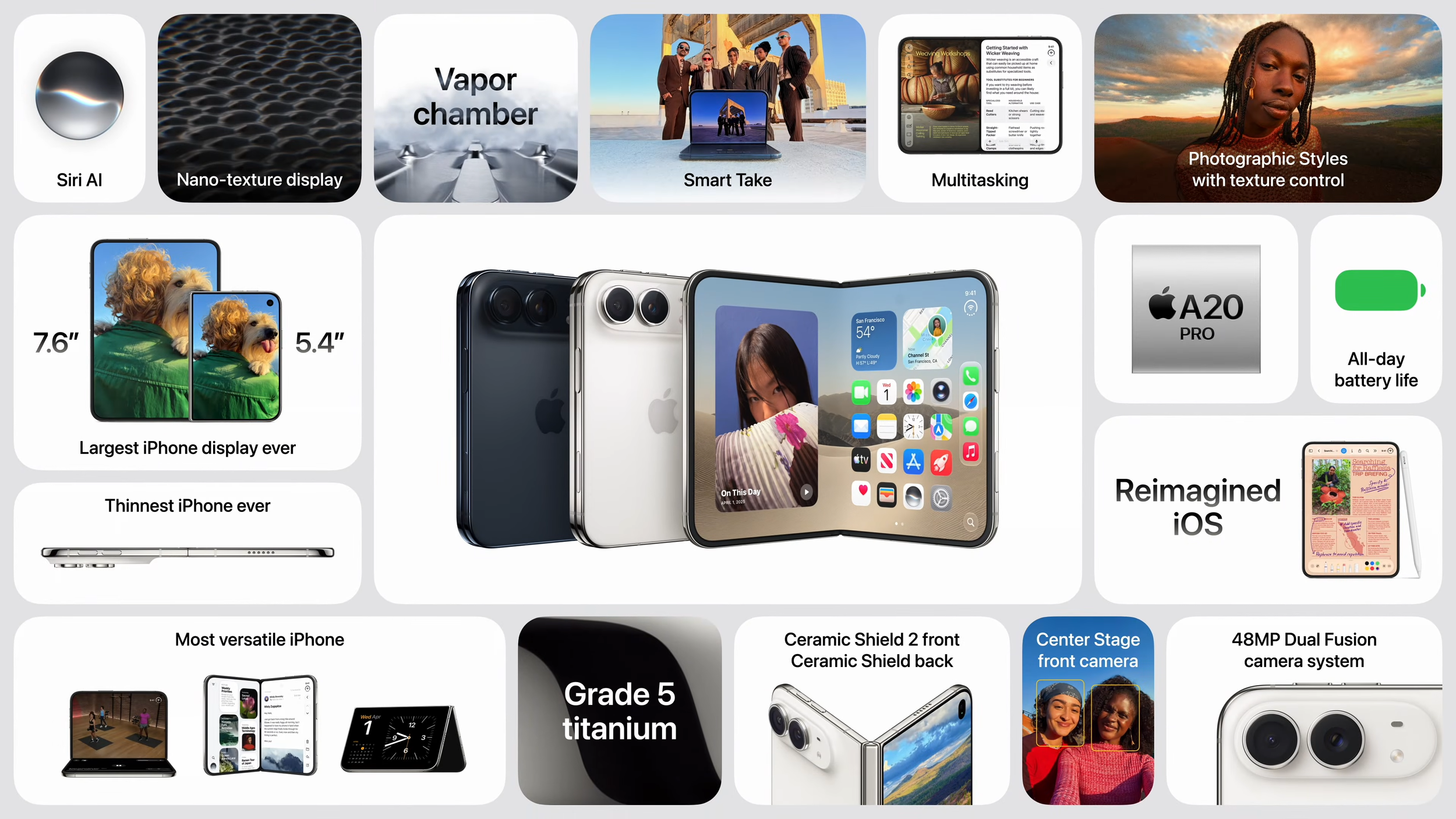
Apple finally made the foldable iPhone. It is called iPhone Duo, and the reveal gives us something much more interesting than another screen-size upgrade.
Closed, it is roughly passport-sized. Open it, and a 7.6-inch display turns the familiar iPhone into something closer to a pocket-sized workspace. But the part worth a closer look is right down the middle. What happens where that screen folds?
Apple Is Taking the Crease Personally
Apple says its custom nano-texture finish reduces glare and reflections, creating a matte surface that makes the crease less visible and feels better under your fingers. That does not mean the fold disappears entirely, but it targets something you notice every time you open the phone.
Underneath is a layered construction: a coated polymer cover, high-strength glass above and below the OLED panel, and a titanium bottom plate. Apple says the cover polymer is up to 40% stiffer than other materials used in the industry.
The clever part is the adhesive. Viscoelastic adhesives let the layers slide relative to one another as the phone folds, like pages in a book. Apple says that movement helps prevent the panel from distorting over time.
The Hinge Is Only Part of the Story
The hinge supports the center of the display when open, while carbon-fiber support plates provide a stiff, lightweight platform. Apple says it also matches individual hinges to their best-fitting housings during manufacturing.
Then comes an unusually specific detail: a laser scans each unit's surface, and up to 25 microscopic layers of photopolymer are printed to correct remaining waviness.
That is a lot of precision going into a surface you will open and close every day. It also makes the eventual repair process especially interesting.
Built to fold. How will it repair?
Apple explained the engineering. These are the questions we want answered when it comes apart.
| The hardware | Why it matters | What we'd inspect |
|---|---|---|
| 01 / SURFACE Nano-textured cover | A matte finish reduces reflections and makes the crease less noticeable. | Can surface damage be repaired without replacing the entire display assembly? |
| 02 / DISPLAY Glass, adhesive, titanium | Protected layers slide relative to one another during folding. | How is the assembly removed, and which layers must be replaced together? |
| 03 / FOLD Carbon-fiber supports + hinge | A rigid platform supports the screen above a hinge with over 100 components. | Can the hinge be replaced separately, and how is its alignment restored? |
| 04 / POWER Two coordinated batteries | A battery in each half is managed as one system. | Can one worn battery be replaced alone, and is calibration required? |
| 05 / PROTECTION Titanium frame + IP68 rating | A reinforced frame and claimed dust and water resistance support durability. | Which seals need replacing after opening, and how is resistance tested? |
Repairability: still an open question. These are inspection questions, not confirmed repair procedures.
Titanium Outside, Two Batteries Inside
The grade-five titanium frame uses structural ribs and ceramic-fiber reinforcement at the antenna breaks. Apple also claims IP68 dust and water resistance, with Ceramic Shield on the back and Ceramic Shield 2 protecting the outer display.
Inside, there is a battery in each half. Custom chips and algorithms manage charging, discharging, and balancing so the two operate as one system. Being eSIM-only worldwide also frees up internal space.
Two screens. Different battery demands.
Apple's estimates use different workloads. Actual battery life varies.
Apple also says the Duo can charge to 50% in around 20 minutes. The unanswered repair detail is how easily those two batteries can be reached when their capacity eventually drops.
There Is a Reason to Open It
The 5.4-inch outer display handles quick tasks, while the larger inner screen supports two apps side by side. Apple says support for Apple Pencil with USB-C arrives later this year on both displays.
Touch ID lives in the side button, and the inner FaceTime camera sits behind the screen. A20 Pro and vapor-chamber cooling power the experience, while 48MP main and ultrawide cameras let you use the outer screen to frame rear-camera selfies.
The iPhone We Want on the Repair Bench
Apple has finally given us an iPhone that opens in a completely different way. The exciting part now is finding out whether its carefully supported display and intricate hinge survive everyday wear—and what happens when they need fixing.
Preorders begin October 16, with availability starting October 23. The reveal is here. The repair story is just beginning.
Based on Apple's presentation in the supplied event transcript. Performance, battery, and durability claims have not been independently tested here.